Cockapoo Barking in Apartment is one of the biggest challenges owners face when living in shared buildings. Hallway sounds, neighbours, deliveries and limited outdoor space can quickly trigger alert barking, demand barking or separation-related barking. Fortunately, most apartment barking problems improve with the right combination of management, positive reinforcement and calm daily routines.
This guide explains why Cockapoos bark more in apartments, how to identify the different types of barking and the most effective ways to reduce unwanted barking without punishment.
Everything’s fine… and then your dog hears a hallway sound, a neighbor door, a distant bark, or a delivery guy breathing near the building and suddenly it’s in full-volume alert mode.
And because it’s an apartment, it feels 10x louder.
Here’s the good news: most Cockapoo barking problems in apartments are very fixable. The bad news is the fix is usually not a single magic trick. It’s a small system of changes that reduces triggers, builds calm habits, and gives your dog a better “default setting” indoors.
This guide is all realistic, apartment-friendly, and based on what actually works for doodle mixes that are smart, sensitive, and a little too good at training humans.
How do I stop my Cockapoo barking in an apartment?
Cockapoo barking in apartment environments is usually caused by alert barking, boredom, separation anxiety or demand barking. The most effective solution combines reducing triggers, teaching calm behaviours, rewarding quiet moments, providing mental enrichment and following a consistent daily routine.
Why Cockapoos Bark So Much (Especially in Apartments)
Cockapoos are a mix of Cocker Spaniel and Poodle, which often means:
- High social awareness (they notice everything)
- Fast learning (including learning that barking makes things happen)
- Big emotions (excitement, frustration, anxiety can show up as barking)
- Strong attachment (prone to separation stress if not trained)
Now add apartment life:
- More shared noise (hallway footsteps, doors, elevators)
- More visual triggers (windows facing parking lots or walkways)
- More restricted outlets (less yard time, fewer decompression breaks)
- More echo and amplification (barks bounce around)
So your Cockapoo isn’t “bad.” They’re reacting to an environment that’s basically designed to set off alert barking.
One owner described this perfectly in aReddit thread about apartment barking struggles, saying their dog was calm in a house but became hyper-alert within days of moving into an apartment. The American Kennel Club guide to excessive barking in dogs explains why alert barking is often reinforced by environmental triggers and how owners can reduce it through consistent training.
Cockapoo Barking in Apartment: Quick Overview
Cockapoo barking in apartment living is usually triggered by shared hallway noise, neighbours, visual stimulation, boredom or separation stress. Identifying the type of barking makes it much easier to choose the right training method.
Step 1: Identify the Barking Type (So You Don’t Train the Wrong Fix)
Most apartment barking falls into one (or more) of these buckets:
1) Alert barking (the “I heard something!” bark)
Triggered by hallway noise, doors closing, people outside, neighbor movement.
2) Demand barking (the “do the thing!” bark)
They bark for attention, play, food, going outside, you getting off your laptop.
3) Boredom barking (the “I need a job” bark)
Usually happens at predictable times, like evenings, or when you’re busy.
4) Separation barking (the “don’t leave me” bark)
Starts shortly after you leave. Often escalates into whining/howling.
5) Fear or reactivity barking (the “go away!” bark)
More intense tone, often paired with lunging at the door/window.
A lot of Cockapoos have a combo: alert barking + demand barking + some separation stress.
If you can, ask a neighbor what they hear and when, or set up a simple phone recording when you step out. That one data point can save you weeks of guessing.
The Apartment Reality: Management First, Training Second
Training is important, but management is what stops you from getting noise complaints while you train.
Think of it like this:
- Management reduces opportunities to bark
- Training changes the habit long-term
You need both.
Fix #1: Block the Two Biggest Triggers (Windows and Front Door)

Window barking: remove the “watch duty”
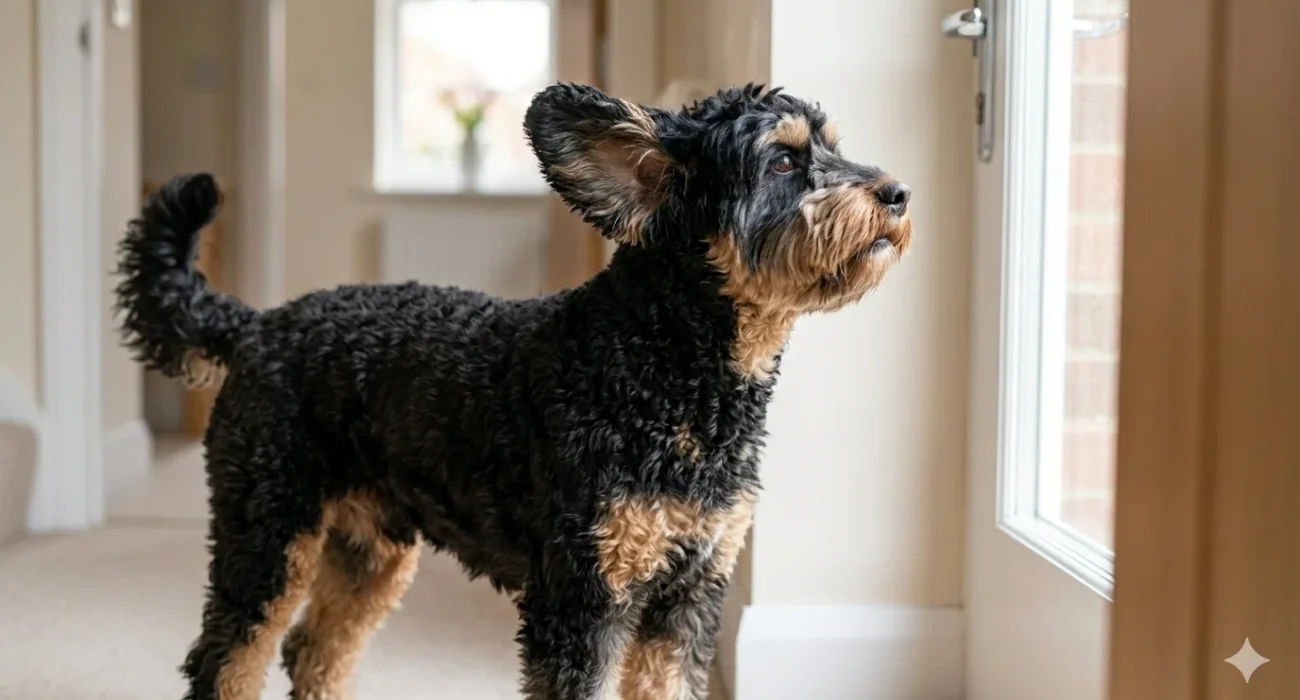
If your Cockapoo posts up at the window like a tiny security guard, you’ll get repeated barking spikes all day.
Realistic fixes:
- Use frosted window film
- Close curtains during peak trigger times
- Move furniture away from windows
You’re not “depriving” your dog. You’re removing a job they’re not emotionally equipped to handle.
Door barking: reduce hallway noise + access
- White noise near the door
- Draft stopper
- Baby gate or pen to create distance
Distance matters more than people think.
Fix #2: Teach the “Thank You” Protocol
This is one of the most effective apartment-friendly techniques.
You’re not stopping barking entirely. You’re teaching:
“One or two barks is enough. Now we relax.”
How it works:
- Dog barks
- You calmly say “thank you”
- Scatter treats away from the trigger
- Dog sniffs → barking stops
This creates a new loop: sound → calm behavior → reward
Another Cockapoo owner shared in this Reddit discussion about alert barking fixes that treat scattering reduced their dog’s barking faster than yelling “quiet” ever did—because it gave the dog something else to do. The RSPCA guide to reward-based dog training explains why rewarding calm behaviour is more effective than punishing barking.
Fix #3: Train a Real “Place” (Mat Training)
This is your apartment superpower.
Instead of reacting to every noise, your dog learns:
“Go here and relax.”
Start simple:
- Reward stepping on the mat
- Reward staying
- Add the cue “place”
- Slowly add distractions
Within 1–2 weeks, you’ll be able to redirect your dog during:
- hallway noise
- guests arriving
- work calls
Fix #4: Stop Accidentally Rewarding Demand Barking
This one is brutal—but important.
If your dog barks and you:
- look at them
- talk to them
- negotiate
- give attention
You’ve just reinforced barking.
The fix:
- No eye contact
- No talking
- Wait for 1–2 seconds of silence
- Then reward
Fix #5: Your Dog Needs Decompression (Not Just Exercise)
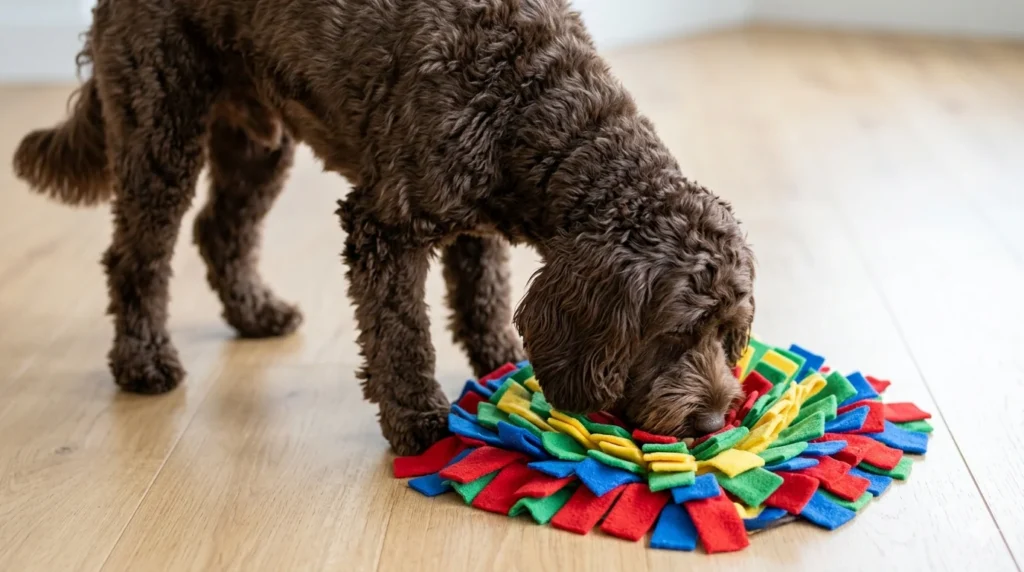
Most apartment dogs are not just “energetic.”
They’re mentally under-stimulated.
Cockapoos need:
- Sniffing
- Chewing
- Problem-solving
- Calm downtime
Simple daily structure:
- Morning: sniff walk (15–30 min)
- Midday: short training session
- Evening: walk + decompression
- Daily: chew + puzzle toy
Fix #6: Use Food the Smart Way
You’re not bribing—you’re reshaping behavior.
Two powerful strategies:
1) Treat scatter (for alerts)
Sound → scatter → sniff → calm
2) Capturing calm
When your dog is quietly resting:
- drop a treat
- walk away
This teaches: calm = reward
Fix #7: Desensitize Hallway Noise
Don’t wait for chaos—train proactively.
- Play hallway sounds at low volume
- Feed treats during the sound
- Stop when sound stops
This changes the emotional response from:
“threat!” → “oh, snacks.”
Fix #8: Separation Barking Needs a Different Plan
If barking happens when you leave, treat it separately.
Signs:
- barking within minutes
- pacing, drooling
- escalation
Start with:
- boring exits
- pre-leave routine
- micro-absences (5 sec → 30 sec → 2 min)
The VCA Animal Hospitals guide to separation anxiety in dogs explains how gradual independence training helps reduce distress-related barking.
Fix #9: Don’t Yell “Quiet”
Train it like a real cue:
- Dog barks
- Show treat
- Dog pauses
- Say “quiet”
- reward
Build duration slowly.
Fix #10: Make Your Apartment Bark-Resistant
Environment matters more than people think.
Sound:
- white noise
- rugs
- door seals
Visual:
- window film
- blinds
- block perches
Calm zones:
- mat
- chew area
- low-traffic rest spot
You’re designing a space where calm is easier than reacting.
A Simple 7-Day Plan
Day 1: reduce triggers
Day 2: start mat training
Day 3: add sniff walk
Day 4: capture calm
Day 5: fix demand barking
Day 6: hallway desensitization
Day 7: combine everything
Most people see noticeable improvement within a week—not perfection, but fewer barking spikes.
The Goal Isn’t Silence
Let’s be realistic.
A healthy goal is:
- 1–2 alert barks, then stop
- faster recovery
- ability to redirect
- no panic when alone
That’s what a “good apartment dog” actually looks like.
Final Takeaway
Cockapoo Barking in Apartment situations are usually caused by normal canine behaviour rather than a “bad” dog. By reducing environmental triggers, rewarding calm behaviour, providing enough mental stimulation and following a consistent training routine, most Cockapoos become much quieter and more relaxed indoors.
Focus on preventing unnecessary barking instead of expecting complete silence. With patience and daily practice, your Cockapoo can learn to ignore common apartment noises and settle calmly at home.
FAQs (Frequently Asked Questions)
Why do Cockapoos tend to bark a lot in apartments?
Cockapoos are highly social, fast learners with big emotions and strong attachment tendencies. In apartments, shared noises like hallway footsteps, visual triggers from windows, limited outdoor outlets, and echo amplification increase their alertness and barking. Their environment naturally triggers more barking as a reaction rather than bad behavior.
What are the common types of barking exhibited by Cockapoos in apartment settings?
Most apartment barking falls into alert barking (reacting to sounds), demand barking (seeking attention or activities), boredom barking (needing mental stimulation), separation barking (anxiety when left alone), and fear or reactivity barking (defensive responses). Many Cockapoos show a combination of these types.
How can I manage my Cockapoo’s barking in an apartment before starting training?
Management involves reducing opportunities to bark by blocking triggers such as window views and hallway sounds. This includes using frosted window film, closing curtains during busy times, moving furniture away from windows, employing white noise machines near doors, adding draft stoppers, and using baby gates or exercise pens to create distance from doors.
What is the ‘Thank You’ Protocol for reducing alert barking in Cockapoos?
The ‘Thank You’ Protocol teaches your dog that after one or two alert barks, it’s time to calm down. When your dog barks at a sound, calmly say ‘Thank you’ and immediately toss 3 to 5 tiny treats away from the door or window. This interrupts the barking loop and encourages sniffing—a calming activity—helping build a new habit of quiet after alerting.
Why shouldn’t I shout ‘thank you’ during the ‘Thank You’ Protocol training?
Shouting can sound angry or like a confrontation, which may escalate your dog’s excitement or stress. The goal is to calmly acknowledge the bark without anger to install a calm habit. A gentle tone helps your Cockapoo understand they’ve communicated successfully and should now settle down.
Can I completely stop my Cockapoo from barking in an apartment?
Completely stopping all barking isn’t realistic or healthy since barking is a natural communication method for dogs. Instead, focus on managing triggers and teaching controlled responses like the ‘Thank You’ Protocol so your Cockapoo alerts appropriately but settles quickly afterward. This balanced approach reduces noise complaints while respecting your dog’s nature.